Broken links and out-of-stock products
Amazon affiliate products out of stock? What happens and what to do
When a product you recommend goes out of stock, the link keeps getting clicks and the page keeps ranking. What changes is that readers can't buy. Here is what Amazon pays in that situation, and how to decide what to do.
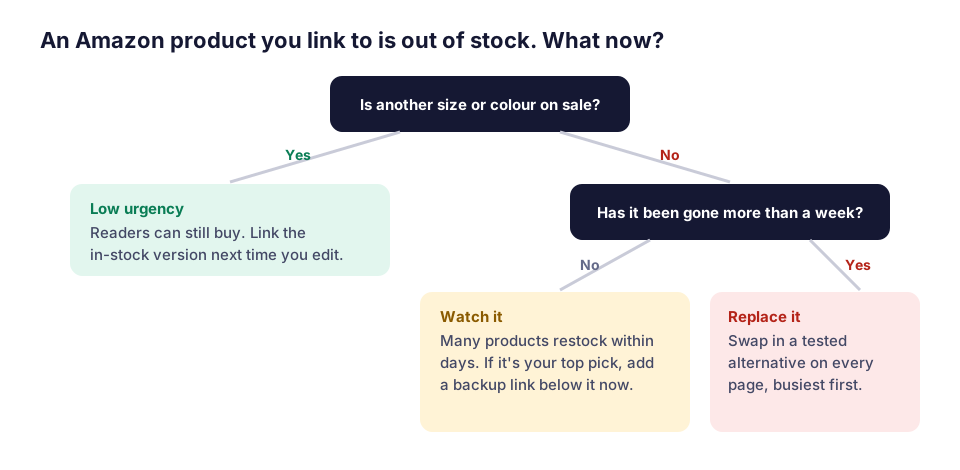
What happens when a linked product goes out of stock
The link still works. The reader lands on Amazon's product page, which now says "Currently unavailable", shows only used or third-party offers, or has no Buy button at all. Three things follow:
- Most readers leave. They came for that product; the page gives them nothing to buy.
- Some buy something else. Amazon pays commission on qualifying products ordered within 24 hours of the click, not only the one you linked. So you may still earn, just less often. (How the 24-hour window works.)
- Nothing tells you. Amazon Associates sends no alert when a product on your site goes out of stock. Clicks stay the same while conversions drop, and it looks like a slow month.
Five states that all look like "out of stock"
When Affiliwatch reads stock through Amazon's API, it sees several different situations that readers experience as "I can't buy this". They call for different responses.
| What Amazon reports | What it means | Usual response |
|---|---|---|
| Out of stock | No one can buy it right now | Wait a few days, then replace |
| No offer to buy | The listing exists but nobody is selling it | Replace |
| Pre-order | Not released yet | Leave it |
| Only this size or colour is out | Other versions are on sale | Low urgency |
| No data from Amazon | Amazon won't report on it | Open the link and decide (why) |
The "only this version" case is common for clothes, shoes and gear sold in sizes. A link to the size-9 boot fails when size 9 runs out, but the reader can pick size 10 on the same page. Treat it as a tidy-up, not an emergency.
Wait or replace? A simple rule
Many products restock within a few days, so replacing the moment something goes out of stock creates churn and can swap a great product for a worse one. A practical rule:
- Gone less than a week: wait. If it's the top pick on a busy page, add a backup link underneath it now.
- Gone more than a week, or "no offer to buy": replace it.
- Removed listing or invalid ASIN: replace immediately; it's not coming back.
Amazon's own policies point the same way: they ask Associates to promptly delete Program Content that is no longer displayed on Amazon or that Amazon says is unavailable.
How to choose a replacement that converts
A replacement has to earn its place on the page, not just fill the gap.
- Look for the same product first. A newer model, another size or colour, or the same item from the manufacturer's own Amazon listing keeps your review accurate.
- Match the role. If the dead product was your "best budget" pick, the replacement has to be cheaper than your "best overall", not just similar.
- Check the basics on Amazon: sold or shipped by Amazon or a well-rated seller, a steady review history, and no "Frequently returned item" notice.
- Update the words, not just the link. If the text names the old product or describes its features, edit it. A link that says "the Cosori 5.8-quart" and opens a different brand loses trust.
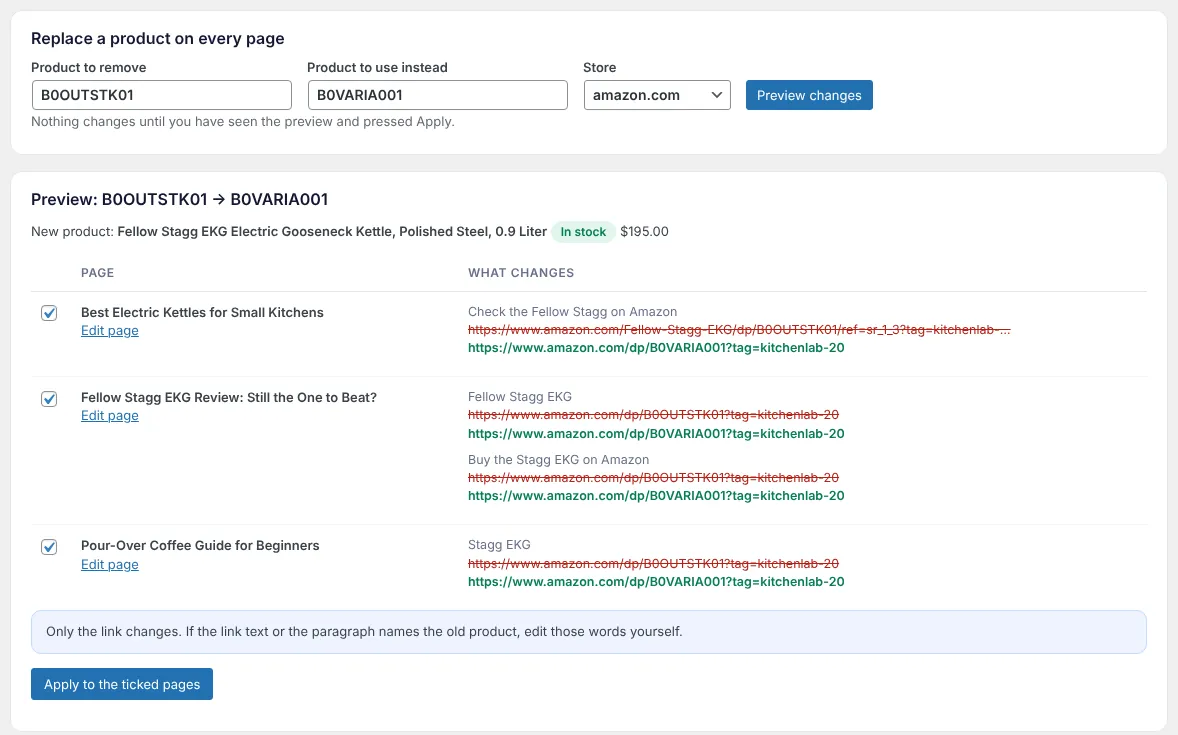
- Swap it everywhere. The same product is often linked from five or ten pages. Replace it on all of them at once.
Affiliwatch does steps 1 and 5 for you: it suggests up to three in-stock replacements, starting with other versions of the same product, and swaps the link on every page after showing you a preview.
Protect your best pages before it happens
- Keep a backup pick under each top recommendation: "If it's out of stock, the X is a close second."
- Avoid single-seller products for top picks where you can. Products sold by Amazon or with many sellers go out of stock less often.
- Link to the product, not a variation you can't control, when the size or colour isn't the point of the recommendation.
- Check your busiest pages weekly, or let a tool check every page daily.
The cost of doing nothing
A roundup that sends 1,000 clicks a month to Amazon, converting at a typical few percent on a $100 product at 3%, earns real money every month. If its top pick dies and conversions drop by half, that loss repeats every month until someone notices. On most affiliate sites the fastest raise isn't new content; it's making the clicks you already get count again. Start with finding every broken link.
Questions people ask
Do I get paid if a reader buys a different product after clicking an out-of-stock link?
Should I remove links to out-of-stock products?
Does an out-of-stock product hurt my rankings?
How do I find out-of-stock products across my whole site?
Sources
Checked on November 17, 2026. Amazon changes its terms from time to time; the linked pages are the final word.